



- Precision Bass vs. Jazz Bass: body designs
- Fender P-Bass and Jazz Bass necks compared
- Jazz Bass vs. Precision Bass: sounds and electronics
- Who makes Precision and Jazz basses?
- P-Bass vs. J-Bass: key specs compared
- Which bass guitar should I buy?
- FAQs
The Fender Precision Bass was a real game-changer when it arrived in 1951. Following the launch of the Telecaster electric guitar the previous year, acoustic double bassists were struggling to be heard. The fretted P-Bass gave those players a way to keep up. Not only could it be amplified, but its compact, less cumbersome design also made it easier to transport between gigs.
Fender’s Jazz Bass followed in 1960. Originally dubbed the Deluxe, it took design cues from the curvy Jazzmaster offset guitar and offered a more refined sound and feel aimed at jazz musicians (hence the name). For many players, the J-Bass raised the bar for contemporary bass design, providing a versatile platform that encouraged new playing styles and musical experimentation.
In short, both of these Fender bass guitars have played a huge role in shaping modern popular music. They’ve appeared on countless records and been wielded by some of the world’s most influential musicians. But which model is the best match for you? We’ve compared their key features, sounds and specs to help you decide.
Precision Bass vs. Jazz Bass: body designs
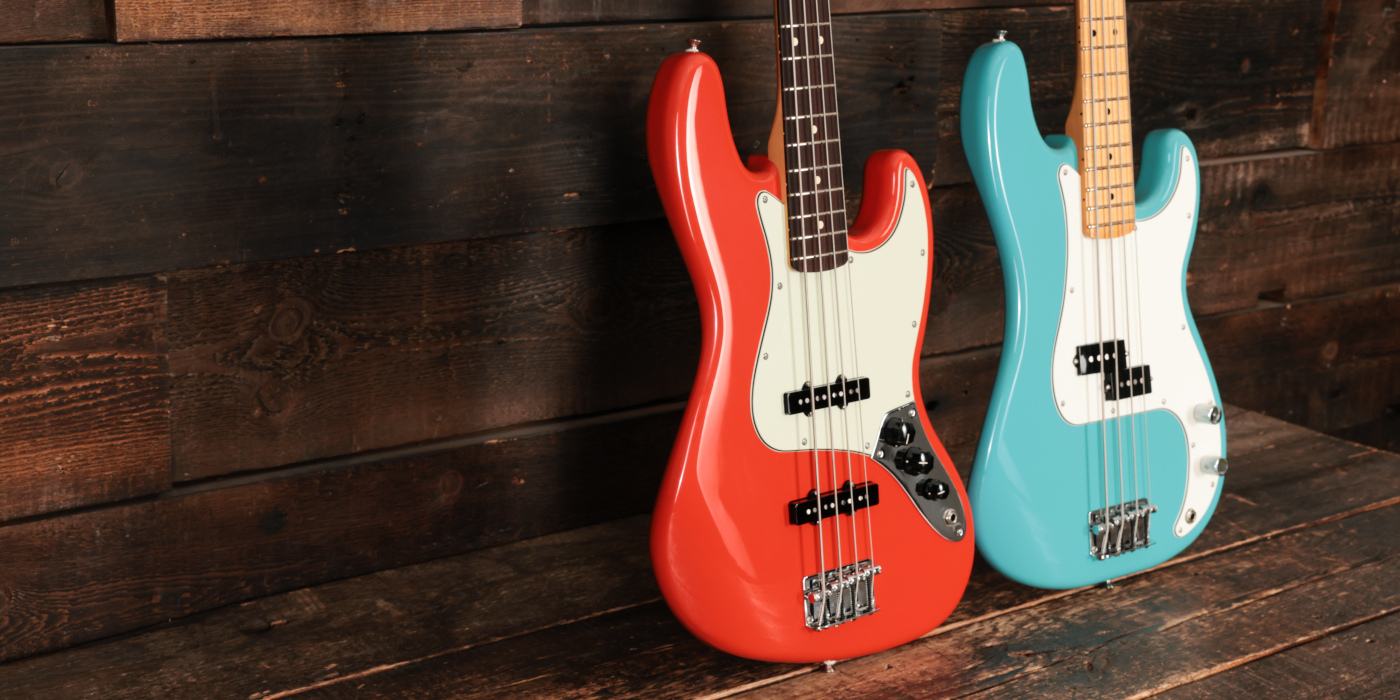
The most obvious visual difference between a Fender Precision Bass and Jazz Bass is the body shape. While the P-Bass was designed to complement the Telecaster when it was first introduced, its double-cutaway body was quite different and would later inspire the legendary Stratocaster silhouette we’re all familiar with today.
The Jazz Bass has a similar double-cut design, but its offset body shape sets it apart from the P-Bass’s more symmetrical profile. For many players, this gives the J-Bass a sleeker, more elegant look.
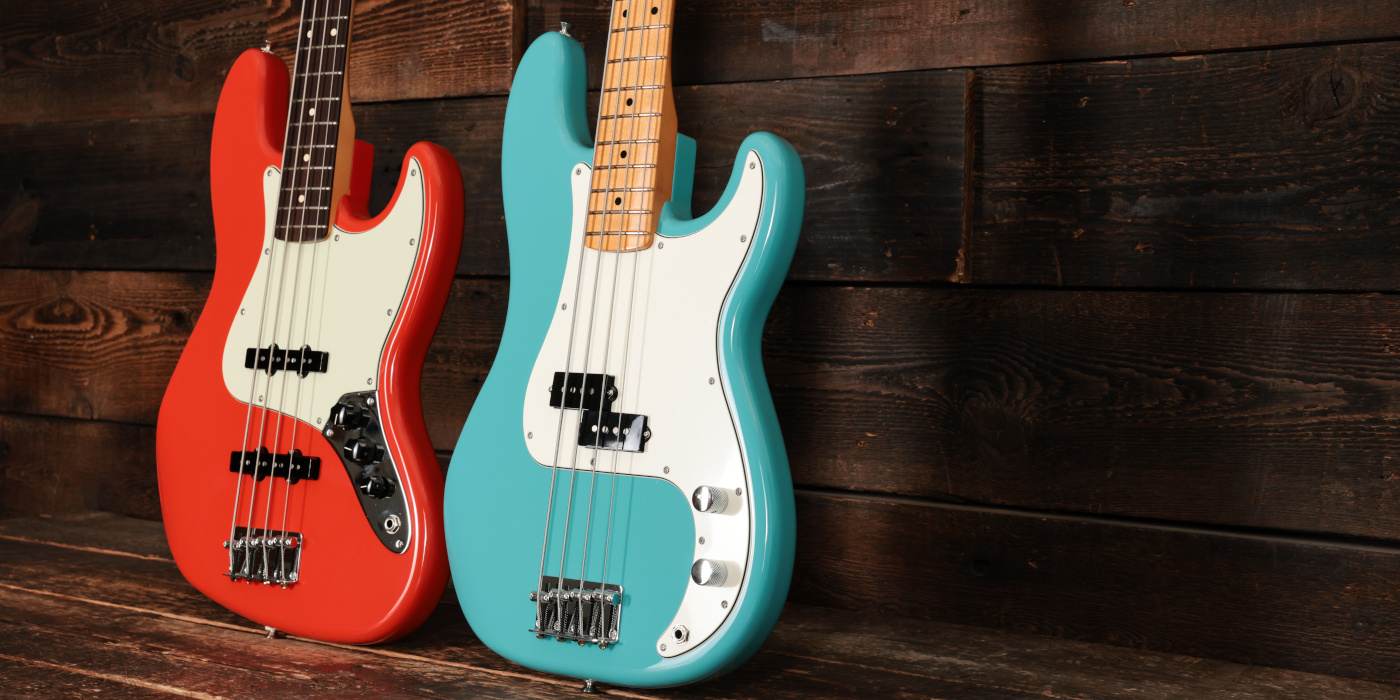
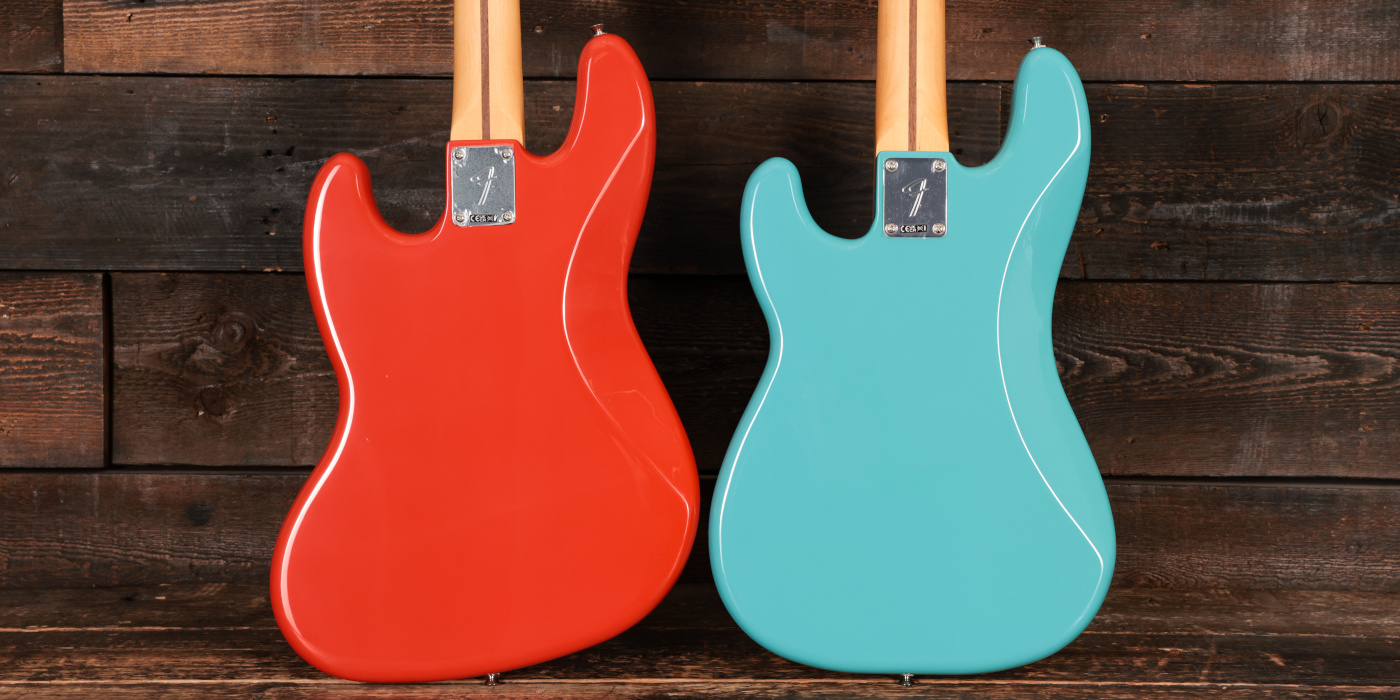
In terms of performance, though, there’s not much to separate them. They’re similarly sized and weigh roughly the same, with both models commonly featuring Alder bodies. Both bass guitars also boast ergonomic forearm contours and belly cuts that make them super comfortable to play.
Fender P-Bass and Jazz Bass necks compared
The necks are where the Precision Bass and Jazz Bass really start to differ. While most current P-Bass and Jazz Bass models have Maple necks carved to a comfy modern “C” profile, they actually feel pretty different in the hand. But how so?
A Fender Precision Bass neck is wider at the nut, usually measuring around 41.3 mm. This gives it a chunkier feel in the lower positions and a little more space between the strings. A Jazz Bass neck, however, is typically narrower at 38 mm at the nut. With the strings sitting slightly closer together, many bassists find that its more tapered neck design feels faster and easier to play.
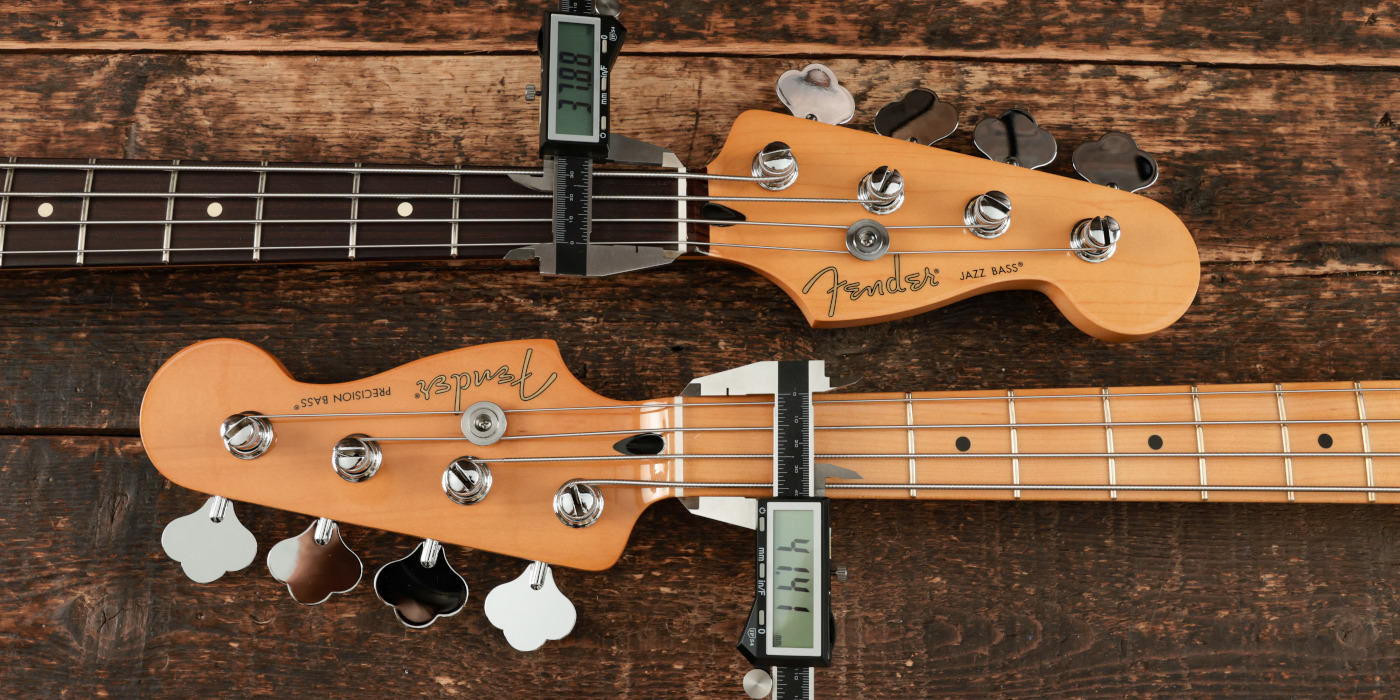
Most Precision and Jazz Bass models feature 20-fret Maple or Rosewood fingerboards and a standard 34-inch scale length (the distance between the bridge and the nut). Depending on the model, you’ll get either a modern 9.5-inch fretboard radius (not too flat, not too curved) or a rounder vintage-style 7.25-inch radius.
Jazz Bass vs. Precision Bass: sounds and electronics
Both the Fender Precision Bass and Jazz Bass have their own signature sound, and that could be the deciding factor when choosing between them. Here’s a closer look at how their electronics differ and the kinds of tones they’re known for producing…
What does a Fender Precision Bass sound like?
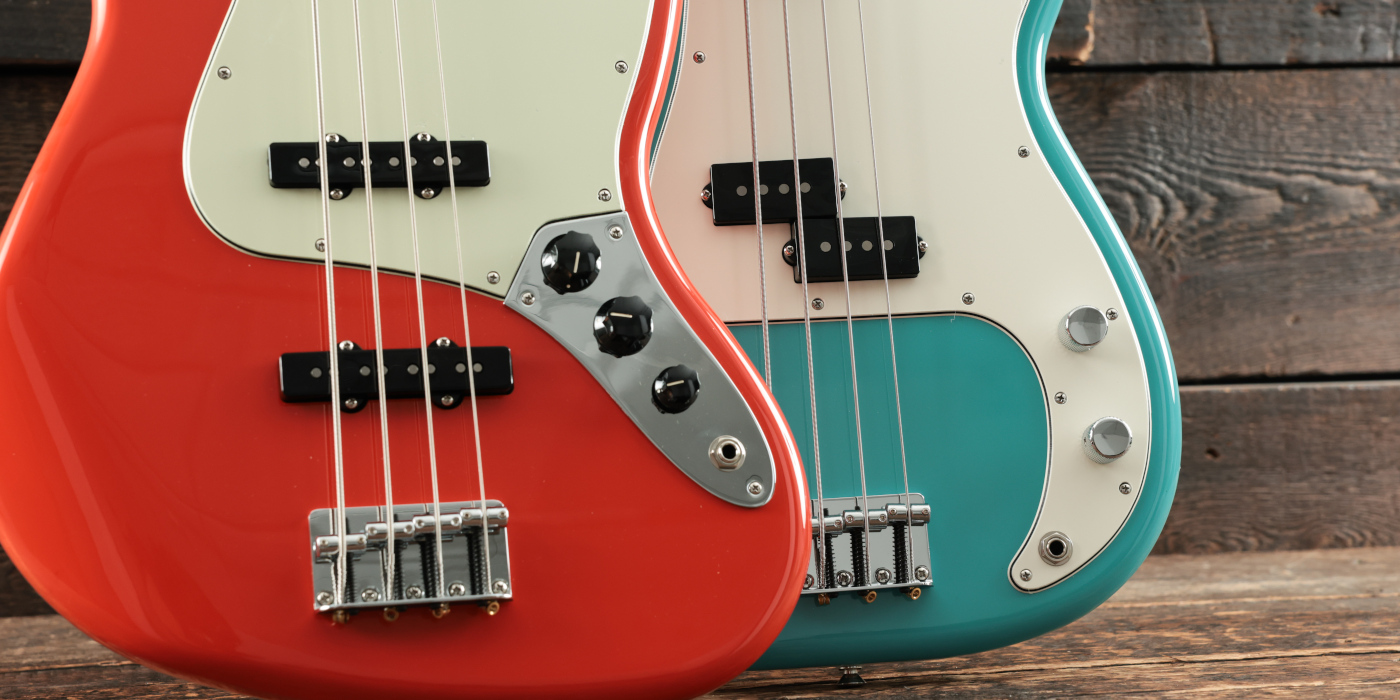
When first introduced in the early ‘50s, the Fender Precision Bass sported a chrome-plated single-coil pickup. In 1957, Fender switched to the hum-cancelling split-coil design that most players now recognise as the definitive P-Bass pickup. On most models, it’s paired with a master volume and master tone control for a simple and intuitive setup.
This famous split-coil pickup serves up the thick, punchy and warm sound that’s become synonymous with the Precision Bass. Its unmistakable low-end “thump” sits great in almost any mix, making it a staple across loads of genres. Whether you’re playing pop, rock, punk or country, a P-Bass rarely feels out of place. Add some overdrive, and it takes on a fat mid-range growl that’s ideal for heavier styles.
Many Precision Bass players also favour flatwound strings for their mellow, vintage-inspired sound. Compared to brighter roundwound bass guitar strings, flatwounds smooth out the top end and enhance the woody, rounded character that makes the P-Bass such a great choice for jazz, soul and R&B.
Fender Jazz Bass tone explained
The Fender Jazz Bass is considered more versatile than a Precision Bass. That’s largely thanks to its dual single-coil pickup configuration and independent volume controls, which allow you to blend the pickups to taste and access a wider range of sounds. The bridge single-coil adds bite and definition, while the neck pickup delivers a fuller voice, giving the J-Bass plenty of mid-range attack and top-end presence.
These characteristics make the Jazz Bass well suited to styles that demand clarity, dynamics and note definition, such as jazz, funk, fusion, progressive rock and metal. It’s no surprise that legendary bassists like Jaco Pastorius, Marcus Miller, Flea (Red Hot Chili Peppers) and Geddy Lee (Rush) have all relied on Jazz Basses throughout their careers.
The J-Bass is also a top choice for more aggressive playing styles, particularly slap bass. And many players pair Jazz Basses with roundwound strings to maximise their brightness and punch. Some even use a strip of foam near the bridge to dampen unwanted overtones and achieve a tighter, more controlled sound.
What is a Fender PJ Bass?
In some of its ranges, Fender offers Precision and Jazz Bass hybrids that give you the best of both worlds. These are known as ‘PJ Basses’, which are typically Precision Bass guitars featuring a traditional split-coil pickup in the middle position alongside a single-coil Jazz Bass bridge pickup. This combo pairs the deep, punchy low-end thump of a P-Bass with the added definition of a J-Bass bridge pickup.
PJ Basses also tend to feature a Jazz Bass-style control layout, with separate volume controls for each pickup and a master tone control. Many models are fitted with a Jazz Bass neck too, giving them a slimmer feel thanks to the narrower 38 mm nut width.
Who makes Precision and Jazz basses?
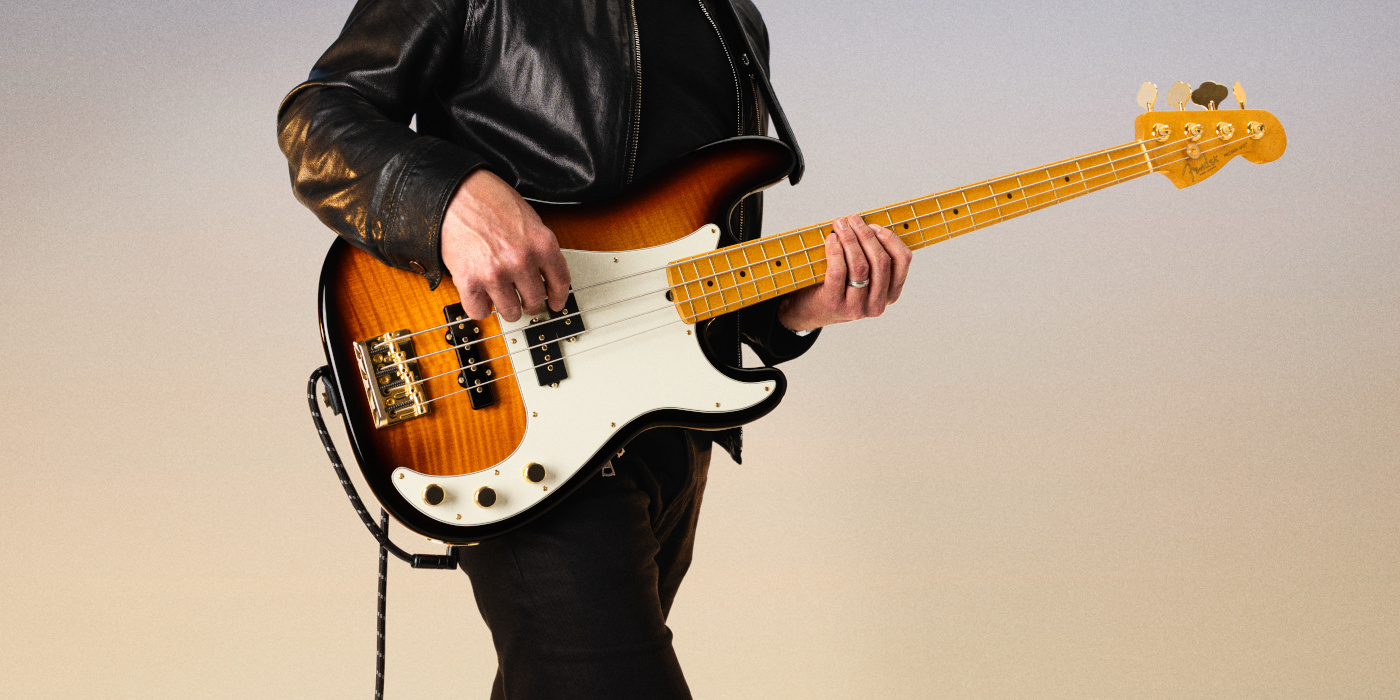
Fender pioneered the mass-market electric bass guitar with its original Precision Bass and Jazz Bass designs (thanks, Leo Fender). Today, both models are available across various Fender ranges, from the entry-level Standard Series and mid-range Player II Series to the high-end, performance-focused American Ultra II Series. Plus, Fender offers signature instruments developed with some of the world’s most prominent bassists as part of its Artist Series.
Fender’s budget-friendly sister brand, Squier, also crafts several takes on the Precision Bass and Jazz Bass. The Classic Vibe Series is especially popular, combining old-school finishes with authentic retro specs at an affordable price point. They’ve got loads of mojo!
And don’t forget that plenty of other brands build basses inspired by the legendary P-Bass and J-Bass designs. That includes Sire with its acclaimed Marcus Miller Series, as well as EastCoast, which produces some of the best bass guitars for beginners.
P-Bass vs. J-Bass: key specs compared
Want a quick summary? Here’s a handy side-by-side comparison of the main differences between a Precision Bass and a Jazz Bass:
| Feature | Precision Bass | Jazz Bass |
|---|---|---|
| Number of strings | 4 | 4 or 5 (model-dependent) |
| Body shape | Symmetrical double-cutaway | Offset-waist double-cutaway |
| Body wood | Typically Alder (varies by model) | Typically Alder (varies by model) |
| Neck profile | Commonly a modern “C” shape with a chunkier feel | Commonly a modern “C” shape with a slimmer, more tapered feel |
| Scale length | 34″ (864 mm) | 34″ (864 mm) |
| Nut width | Approx. 41.3 mm | Approx. 38 mm |
| Fingerboard | Maple, Rosewood or Ebony (model-dependent) | Maple, Rosewood or Ebony (model-dependent) |
| Number of frets | Typically 20 | Typically 20 |
| Fretboard radius | 9.5″ on most modern models | 9.5″ on most modern models |
| Pickup(s) | Single split-coil | Dual single-coils |
| Controls | Master volume, master tone | Neck pickup volume, bridge pickup volume, master tone |
| Character | Thick, punchy, warm and direct | Bright, articulate and versatile |
| Best for | Pop, rock, punk, country and soul | Jazz, funk, fusion, slap bass, prog and metal |
| For players who | Want simplicity and a strong fundamental tone | Want greater tonal flexibility and blending options |
Which bass guitar should I buy?
Both the Jazz Bass and Precision Bass have decades of history behind them, and there’s a good reason they’re still among the world’s most popular bass guitars.
The Jazz Bass benefits from its slimmer neck and wider tonal range. It’s a highly flexible instrument that can cover jazz, funk and rock with ease, whether you prefer fingerstyle, a pick or slap bass techniques. So, if you love hopping between different playing styles and genres, the Jazz Bass is likely the better fit.
The Precision Bass, on the other hand, is all about timeless tone. It might offer a simpler playing experience, but its signature sound has been heard on countless classic recordings for a reason. Thick, punchy, authoritative — there’s nothing quite like the rumble of a P-Bass!
Still can’t decide? A PJ Bass could be the perfect middle ground, combining the girth and power of a Precision Bass with the added bite and versatility of a Jazz Bass bridge pickup, plus a skinnier neck to boot.
FAQs
What’s better, a P-Bass or Jazz Bass?
Neither is objectively better. A Fender Precision Bass is known for its thick sound and straightforward controls, while a Jazz Bass offers a slimmer neck and greater tonal flexibility with its dual-pickup design. If you value simplicity and powerful low-end, choose a P-Bass. If versatility is your priority, go for a Jazz Bass.
Are Jazz Basses heavier than P-Basses?
Most Fender Jazz Basses and Precision Basses are very similar in size and weight, often sharing the same body woods. The exact weight will vary depending on the model, materials and hardware, but there’s generally little difference between the two when it comes to comfort and portability.
Is a Jazz Bass easier to play than a Precision Bass?
Many bassists find a Jazz Bass easier to play thanks to its narrower 38 mm nut width and slimmer neck profile. The strings sit slightly closer together, which can make fast runs, intricate fingerstyle playing and slap techniques feel more comfortable. That said, plenty of bassists love the fuller feel and wider string spacing of a P-Bass neck.
Who plays Precision Basses?
The Fender Precision Bass has been used by loads of legendary players across almost every genre. Famous P-Bass users include Motown icon James Jamerson, Beach Boys co-founder Brian Wilson and funk pioneer George Porter Jr., while punk and rock players such as Dee Dee Ramone, Paul Simonon, Mike Dirnt, Steve Harris, Duff McKagan and Nate Mendel have all helped cement its reputation as one of the most recorded bass guitars of all time.
Which artists use a Jazz Bass?
Notable Fender Jazz Bass users include Noel Redding, Jack Casady, Verdine White, Larry Graham, Greg Lake, Jaco Pastorius, Marcus Miller, Geddy Lee, John Paul Jones, Adam Clayton and Flea, all of whom have used the expressive Jazz Bass to shape some of the most influential recordings in rock, funk, jazz and beyond.
Learn more of the bass-ics
If the P-Bass has won you over, check out our our Fender Precision Bass buyer’s guide, where we break down all the different models in Fender’s current lineup. Prefer the Jazz Bass? Head over to our Fender Jazz Bass buyer’s guide to discover which J-Bass is the best fit for your playing style.
If you’re after some juicy product gossip, our gear news page is well worth a look. Or for proper nerdy deep dives and how-to guides, our learn section is the place to be.
Responses & Questions