



- Strymon TimeLine MX vs. TimeLine: comparison table
- Price and availability
- Design and size
- Sounds
- Processing power
- Built-in loopers
- Strymon TimeLine MX: extra features
- Is the Strymon TimeLine MX better than the TimeLine?
- Strymon TimeLine MX on Andertons TV
There are dozens upon dozens of brilliant delay pedals out there. But the Strymon TimeLine has remained one of the category’s benchmark models ever since it debuted at the 2011 NAMM Show. And 15 years later, the highly anticipated sequel is finally here — the Strymon TimeLine MX. Better late than never!
This release comes more than two years after Strymon unveiled its upgraded flagship reverb stompbox (the BigSky MX). So, we’ve been eagerly waiting for their trailblazing, top-of-the-range delay to get the same treatment.
But how do you make one of the best delay pedals ever even better? Well, you’re about to find out. We’ve put the new Strymon TimeLine MX up against the original TimeLine to help you decide whether it’s worth upgrading — or if you’re simply looking for an incredibly powerful echo workstation for your pedalboard.
Strymon TimeLine MX vs. TimeLine: comparison table
Before we take a closer look at the TimeLine MX’s mighty specs and features, here’s a quick overview of how it stacks up against the standard TimeLine pedal:
| Feature | TimeLine MX | TimeLine |
|---|---|---|
| Processor | Tri-core 800 MHz ARM | Single 266 MHz SHARC DSP |
| Number of machines at once | 2 | 1 |
| New MultiTap delay engine | Yes (customise up to 8 unique taps to create complex rhythmic delays and textural reverbs) | No |
| New Spectral Granular delay engine | Yes (experience Strymon’s own unique, versatile and tempo-focused take on granular synthesis) | No |
| Oil Can delay engine | Yes (pair with any other delay type or double up Oil Cans for twice the vintage warble) | No |
| Drum delay engine | Yes (customise up to 4 unique drum heads for complex and rhythmic delays) | No |
| Dedicated Reverb engine | Yes (create everything from intimate rooms to long atmospheric ambiences) | No |
| Tremolo delay | Yes (now available within the updated and highly-customisable Filter delay engine) | Yes (using Trem delay engine only) |
| Swell functionality | Yes (now a unified parameter available to use in conjunction with all delay types) | Yes (using Swell delay engine only) |
| Ducking functionality | Yes (now a unified parameter available to use in conjunction with all delay types) | Yes (using Duck delay engine only) |
| Classic TimeLine delays | Yes (in addition to new types, classic TimeLine delays are available via the Voice parameter) | Yes |
| New 1-button Quick Looper mode | Yes (assign the Tap footswitch or a MiniSwitch to be a dedicated, always-on 1-button looper) | No |
| Dedicated Looper mode | Yes (with multiple routing options and a highly-visible UI for improved stage performance) | Yes |
| Maximum loop length | 5 minutes | 30 seconds |
| Internal audio routing options | Mono in / Mono out, Mono in / Stereo out; Stereo in / Stereo out + Series, Parallel, Split (in Dual mode) | Mono in / Mono out; Mono in / Stereo out; Stereo in / Stereo out |
| Audio pan control | Yes (freely shift your delayed signals across the stereo field) | No |
| Audio in / out | Stereo in / out, Stereo send / return | Stereo in / out |
| Discrete Class A JFET preamps | Yes | No |
| MIDI in / out | DIN, TRS and USB MIDI | DIN |
| USB | Yes (USB-C) | No |
| External hardware effects loop | Yes (complete with multiple routing and placement options) | Yes |
| External control | Yes (using MiniSwitch, MultiSwitch or MultiSwitch Plus) | Yes (using MultiSwitch or MultiSwitch Plus) |
| Display Type | OLED | LED |
| Dimensions (W x D) | 7 x 5 inches / 177.8 x 127 mm | 6.75 x 5.1 inches / 171.5 x 129.5 mm |
Price and availability
The Strymon TimeLine delay pedal was released back in January 2011, if you can believe it (time flies, eh?). And despite being 15 years old, it’s still one of the most popular high-end delay pedals on the market. At the time of writing, you can pick one up for around £429. The Strymon TimeLine MX landed on 7 July 2026, bringing a host of new sounds and features. Those upgrades come at a premium though, with the MX priced at £699.
Design and size
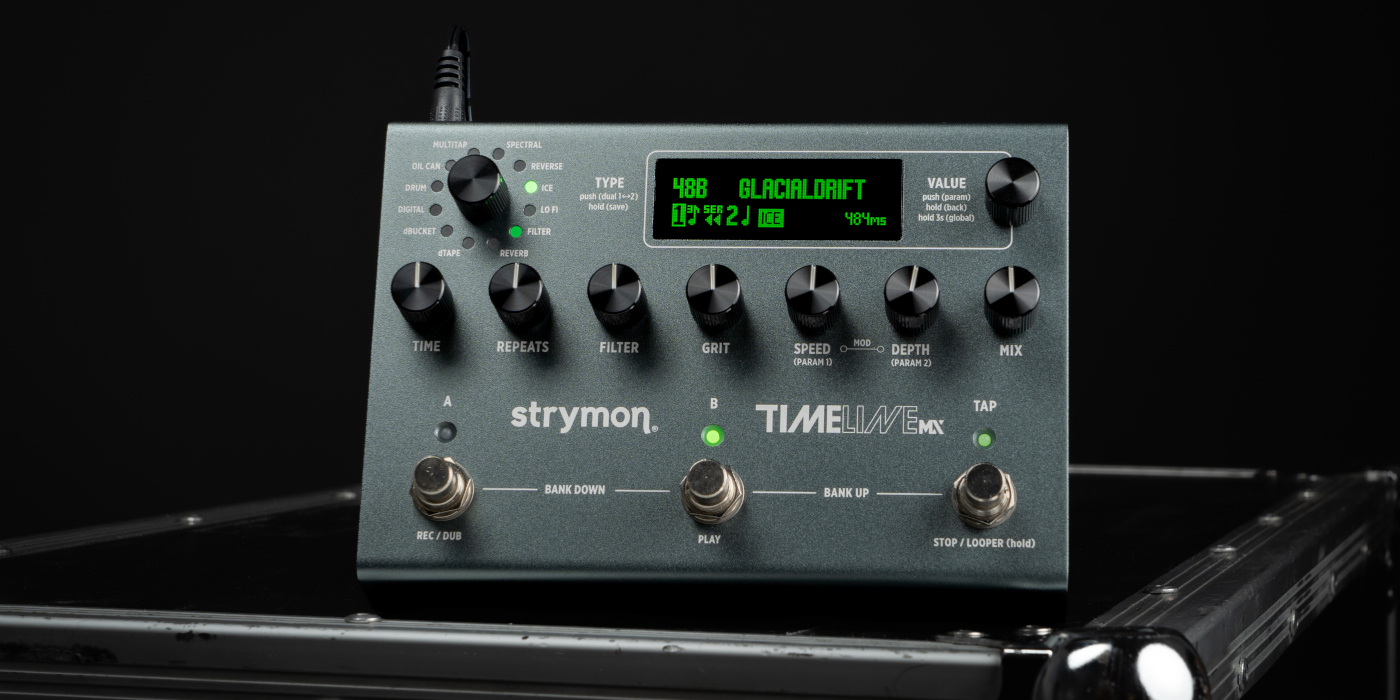
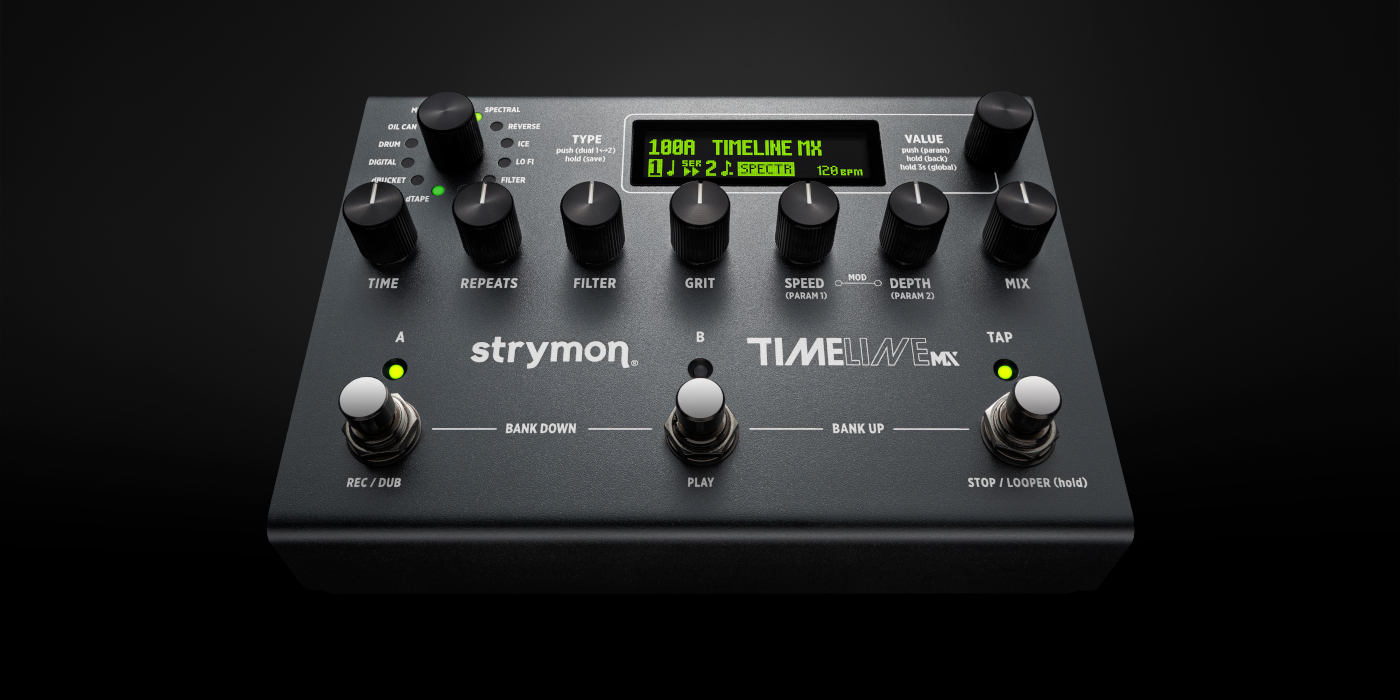
At first glance, you’d struggle to tell the two apart. Both the Strymon TimeLine and TimeLine MX have the same cool gunmetal-grey finish and are almost identical in size, with the MX measuring just a few millimetres wider. That means if you do decide to upgrade, you’ll have no trouble swapping ‘em out on your board. The footswitch layout is unchanged too, so you won’t be making any missteps when changing presets or controlling the onboard looper (more on that later).
Look a little closer though, and you’ll see what Strymon has done to make things a tad more intuitive on the MX. Most obvious is the larger OLED display, which has been moved to the middle of the front panel. Not only is it brighter and easier to read under harsh stage lights, but with a little extra real estate, you can see more info on your patch’s parameters, audio routing and the looper functions.
The controls have also had a bit of a shift around. The delay Type selector remains on the left-hand side but now sits where the display used to be, while the Value dial has moved all the way to the right to keep it close to the screen. All the other controls are now neatly laid out in a single row beneath them. So, if you’re replacing your TimeLine, you might spend the first few minutes reaching for the wrong knob — but everything should still feel familiar enough.
Sounds
Now we’re onto the part you’re probably most curious about: the sounds. We’ll kick off with a quick summary of the original TimeLine’s delay algos, then dive into the new additions that make the TimeLine MX such an exciting upgrade.
TimeLine
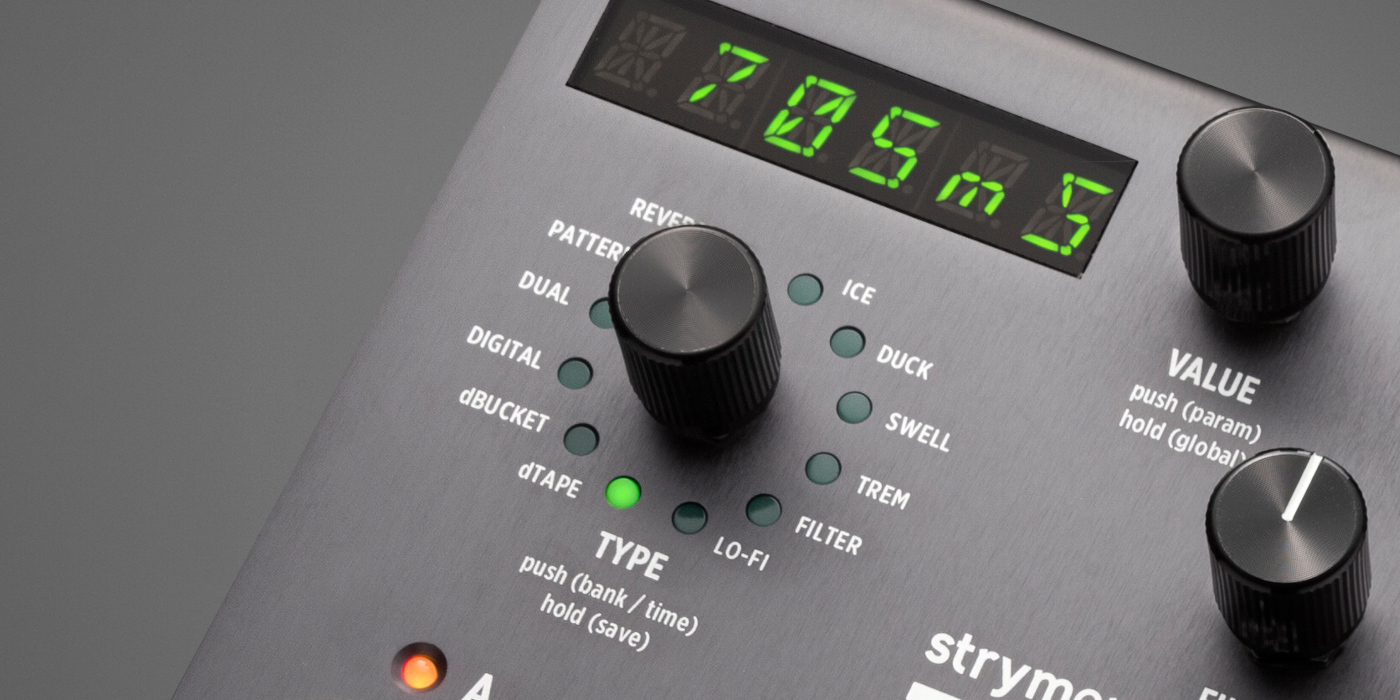
The Strymon TimeLine is loaded with 12 studio-quality delay engines, covering everything from pristine digital repeats and vintage, vibey echoes to huge cinematic soundscapes:
- Digital: A crystal-clear digital delay with extensive tweakability.
- Dual: Two independent delay lines that can be configured in series or parallel for complex rhythmic textures.
- Pattern: A selection of multi-tap delay patterns ranging from rhythmic and percussive to spacious and ambient.
- Reverse: Play forwards and hear your repeats played back in reverse.
- Ice: Chops up your signal and replays it with selectable pitch-shifted intervals for shimmering, otherworldly effects.
- Duck: A dynamic ducking delay with adjustable sensitivity and release controls.
- Swell: Creates automatic volume swells that are perfect for ethereal ambient sounds.
- Trem: Combines delay and tremolo effects, with a choice of triangle, square, sine, ramp and saw waveforms to vary the delay amplitude.
- Filter: Adds a synchronised filter that can be positioned before or after the delay line.
- Lo-Fi: Delivers gritty, bit-crushed repeats inspired by old radios, telephones and other low-fidelity devices.
- dTape: Strymon’s detailed recreation of classic sliding-head tape echo machines.
- dBucket: A rich and nuanced take on vintage analogue delay pedals with bucket-brigade (BBD) circuitry.
TimeLine MX
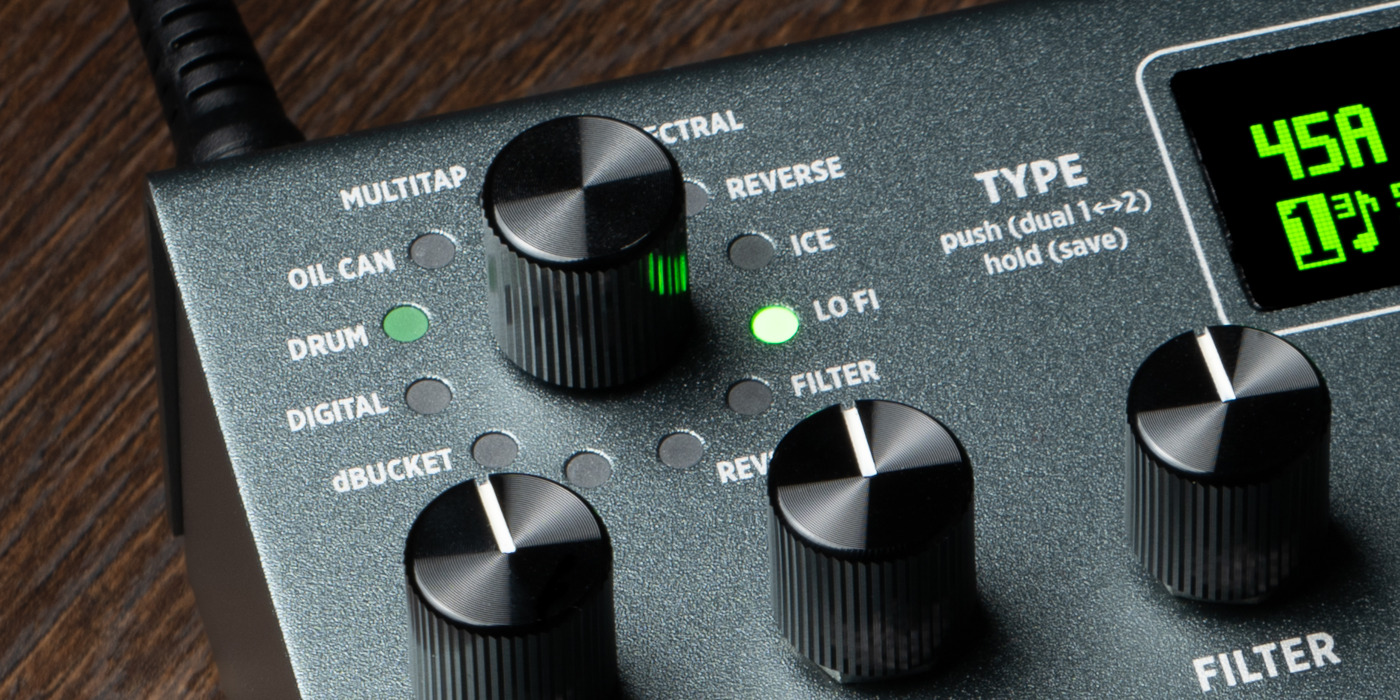
Alongside enhanced versions of Strymon’s classic TimeLine algorithms, the MX introduces four all-new delay machines and even a dedicated reverb engine:
- Spectral: Strymon’s take on granular delay. Slice your signal into fragments and manipulate them with pitch-shifting, reverse playback, time-stretching and filtering to create a montage of glitchy patterns or cool panoramas.
- MultiTap: Ideal for building complex rhythmic delays, with per-tap control over panning, level, filtering and more. You can stick with the built-in patterns or make your own from scratch.
- Oil Can: A recreation of vintage oil-can echo circuits, serving up dark, murky repeats with syrupy modulation and constantly evolving textures.
- Drum: Inspired by classic drum echo units, complete with organic warble and soft-clipped repeats. Adjust the play head spacing, level, feedback and panning to create intricate patterns.
- Reverb: Covers everything from small room sounds to vast washes with long, atmospheric decays. Combined with the delay engines, it makes the TimeLine MX a complete ambience solution in a single pedal.
Wondering where some of the old delay machines around the TimeLine MX’s Type selector have disappeared to? Don’t worry — they’re still knocking about, just organised differently. Trem now lives within the Filter engine, while Duck and Swell have been reworked into global parameters that can be used in conjunction with all delay types.
Processing power
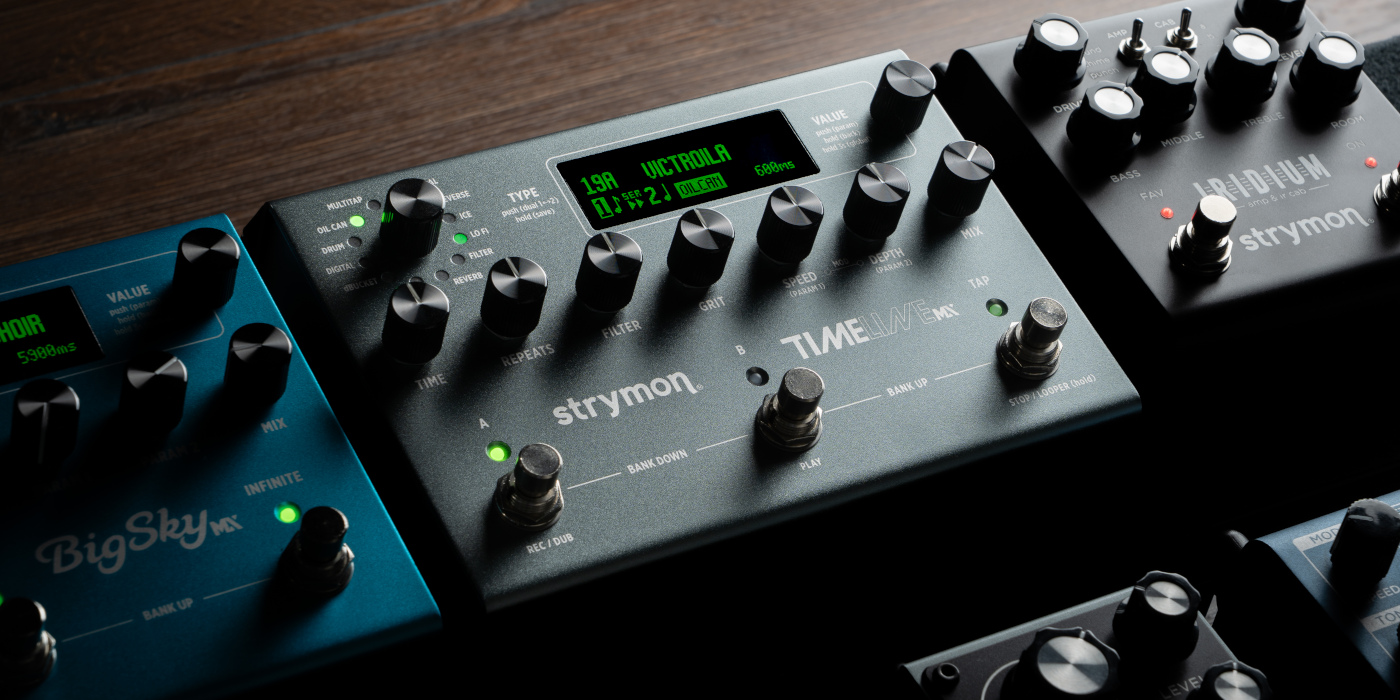
Strymon are the Ferrari of digital guitar pedals, so it’d have been strange if they hadn’t equipped their latest flagship delay with some serious horsepower. Thankfully, they’ve done exactly that by supercharging the TimeLine MX with a tri-core 800MHz ARM processor. That’s a hefty improvement over the original TimeLine’s single 266MHz SHARC DSP.
All that extra processing power has given Strymon’s engineers far more headroom to model the nuances of vintage delays and reverbs in even greater detail. From the subtle inconsistencies of electro-mechanical units to the quirks of classic analogue and early digital designs, the TimeLine MX captures every last detail.
But perhaps the biggest advantage is what that extra grunt lets you do. Unlike the OG TimeLine, the MX can run two effects engines simultaneously. This therefore opens the door to more ambitious sound design, intricate rhythmic textures and combined delay-and-reverb presets.
You can switch between delay machines with a single button press while editing, and the bigger screen makes it easy to see whether your engines are running in Series, Parallel or Split mode. You can even pan the output of each one if you wanna get super creative with your delayed signals across the stereo field.
Built-in loopers
The 30-second stereo looper in the original Strymon TimeLine is fun and useful, but by modern standards it’s fairly limited compared to dedicated looper pedals. Strymon clearly thought the same, because the TimeLine MX boosts the looping time up to a whopping five minutes, complete with reverse and half-speed playback options.
The MX also adds selectable Multi and one-button Quick Looper modes. The latter is especially handy for fast layering and spontaneous improv, as you can access it instantly via the Tap footswitch without having to switch into the dedicated Looper mode. Or hook up a Strymon MiniSwitch and you’ll have an always-on one-button looper at your feet.
What’s more, the looper can be placed either before or after the delay effects, so you can get really experimental. Combined with the expanded routing options and clear on-screen visual feedback in the full-fat looping mode, the TimeLine MX’s looper feels like much more than just a cool bonus feature.
Strymon TimeLine MX: extra features
As if the new delay engines and upgraded looper weren’t enough, the Strymon TimeLine MX also has a few other tricks up its sleeve:
- External hardware effects loop: Like the original TimeLine, the MX features an internal FX loop for integrating external mono or stereo pedals. However, the newer model offers more routing and placement options, making it easier to build elaborate signal chains.
- USB-C connectivity: This is a welcome addition to the MX, with the USB-C port handling firmware updates, MIDI communication and connection to Strymon’s Nixie 2 editor software for deeper patch editing.
- Expanded MIDI control: In addition to traditional 5-pin DIN MIDI, the MX also supports MIDI over USB-C and TRS, giving you more ways to integrate it into modern pedalboard and studio setups.
- Discrete Class A JFET preamps: High-quality analogue input stages help preserve the dynamics, responsiveness and feel of your playing.
Is the Strymon TimeLine MX better than the TimeLine?
In terms of features and flexibility, yes — the Strymon TimeLine MX is a big step forward from the original pedal. With a more powerful processor that lets you use two effects engines at once, the MX also introduces a bigger and brighter screen, refined routing options and four brand-new delay machines on top of enhanced versions of Strymon’s classic TimeLine algorithms.
While the standard TimeLine has a useful 30-second looper alongside its huge library of delay sounds, the new TimeLine MX takes thing further by adding a versatile reverb engine and an expanded 5-minute looper with loads more control. So, it’s essentially three pedals in one!
But that’s not to say that the old TimeLine is history. It’s still an incredible bit of kit, and there’s a reason it’s been a fixture on professional pedalboards for the best part of 15 years. If you don’t fancy dual-engine processing, onboard reverb or long looping times, the standard TimeLine remains a great option. And with the arrival of the Strymon TimeLine 2, you’ll probably start seeing prices fall (especially on the second-hand market). This makes it a perfect time to bag yourself a killer delay workstation for less.
Will the Strymon TimeLine MX catch on as quickly as its predecessor? At £699, it might be more of a slow burner. But given Strymon’s track record and everything the MX brings to the table, we’d be surprised if it doesn’t become a future pedalboard fave. Only time will tell…
Strymon TimeLine MX on Andertons TV
Watch Lee and Pete take a trip through the new Strymon TimeLine MX (fortunately, no flux capacitor required):
Time to upgrade your delay?
Fancy learning more, more, more?
Our delay pedals guide is a great place to start if you’d like to go further down the delay rabbit hole. Or head over to our learn section for more in-depth gear guides, expert advice and helpful how-to articles.
Responses & Questions