



- What is a microtonal guitar?
- How do microtonal guitars work?
- What does a microtonal guitar sound like?
- Which Western artists use microtonal guitars?
- Why are guitarists turning to microtonal instruments?
- What’s the future of microtonal guitar?
- Microtonal guitars on Andertons TV!
- Shop microtonal guitar necks & instruments
- Microtonal guitar FAQs
Microtonal guitars have been bubbling away in the background of experimental music for decades. But lately, they’ve started creeping into more mainstream territory. And with bands like Angine de Poitrine and King Gizzard & the Lizard Wizard flying the microtonal guitar flag, it’s clear that guitarists are hungry for fresh sounds that live between the notes most of us thought were fixed in place.
So, what is a microtonal guitar and how does it actually work? And why are players stepping outside their comfy 12‑tone world for something a little more… wobbly? Let’s dive in.
What is a microtonal guitar?
A microtonal guitar is a modified instrument that lets you play notes in between the standard semitone pitches used in traditional Western music. Most electric guitars, acoustics and basses are built around 12‑tone equal temperament — that’s the system where an octave is divided into 12 equal steps (those familiar frets we’re all used to). But microtonal guitars break free of that by adding extra pitches (usually in the form of additional frets) that simply don’t exist on a standard guitar, unlocking new sounds, scales and musical possibilities.
Those extra pitches might include:
- Quarter tones (24‑TET): Notes that sit halfway between standard frets.
- 19‑tone equal temperament (19‑TET): A system that divides the octave into 19 evenly spaced notes.
- Custom intervals: Often created by the player using movable frets, similar to what you’d find on instruments like the sitar.
Think of it like upgrading your guitar from a box of 12 crayons to a full‑blown artist’s palette. Suddenly, entire emotional colours are on the table that just weren’t accessible before. And while those extra notes might sound like an out‑of‑tune guitar at first, they’re not. Microtonal guitars simply don’t play by the rules Western classical music settled on a few hundred years ago.
It’s also worth saying that microtonal systems aren’t new at all. They’ve been part of non‑Western music traditions for centuries, including:
- Middle Eastern maqam scales.
- Indian raga systems.
- Turkish and Arabic musical traditions.
How do microtonal guitars work?
Microtonal guitars open up those extra notes through modified fingerboards or alternative playing approaches. And while the results might look wild, the ideas behind them are surprisingly logical. Some of the most common designs include:
Additional frets
The most conventional approach (to these unconventional guitars) is adding extra frets between the standard ones, which are calculated to produce specific intervals. Some guitars focus on simple quarter tones, while others take inspiration from Arabic maqam systems, Indian raga scales or more experimental tuning theories. The latter often use custom layouts with split frets divided into smaller segments.
Replaceable or movable frets
Some modern designs use interchangeable or adjustable fret systems, allowing players to physically reconfigure the fingerboard. Fancy experimenting with a new tuning or scale? Simply move the frets and off you go. These setups can enable some seriously complex microtonal chords that wouldn’t be possible on a fixed‑fret guitar.
Fretless guitars
Another popular route is to ditch frets altogether. With no fixed stopping points, fretless basses and guitars offer near‑infinite pitch control — think smooth slides, expressive vibrato and all the microtonal inflections your fingers can muster. Much like a violin, you’re free to land anywhere between notes. The catch? Intonation is entirely down to you. No pressure…
What does a microtonal guitar sound like?
At first? Pretty darn weird, but not in a bad way. Microtonal guitars can sound unfamiliar or even a little alien compared to standard Western music. Because so much of what we’re used to is built around predictable harmonic resolution, hearing notes slip between the cracks can feel surprising yet expressive.
Microtonal intervals hover, pull, ache and slide in ways that standard frets just don’t allow, giving phrases a sense of movement and emotion that can feel almost vocal. Used subtly, microtonality can enhance your phrasing by adding extra shades of feeling between the notes.
But push it harder, and things can get properly disorienting and even unsettling. That makes microtonal guitars a perfect fit for metal, experimental film scoring or musicians who enjoy making audiences squirm a bit, like Angine de Poitrine. And no, it’s not just down to the costumes!
Which Western artists use microtonal guitars?
As we’ve established, microtonal guitars aren’t exactly a brand‑new thing. It’s just taken modern Western players a little while to fully embrace them. That said, a growing number of daring musicians have well and truly caught the microtonal bug:
- King Gizzard & the Lizard Wizard: Probably the most famous contemporary champions of microtonal guitar. Albums like Flying Microtonal Banana brought the sound into indie rock consciousness, proving microtonality can be groovy, catchy and fun.
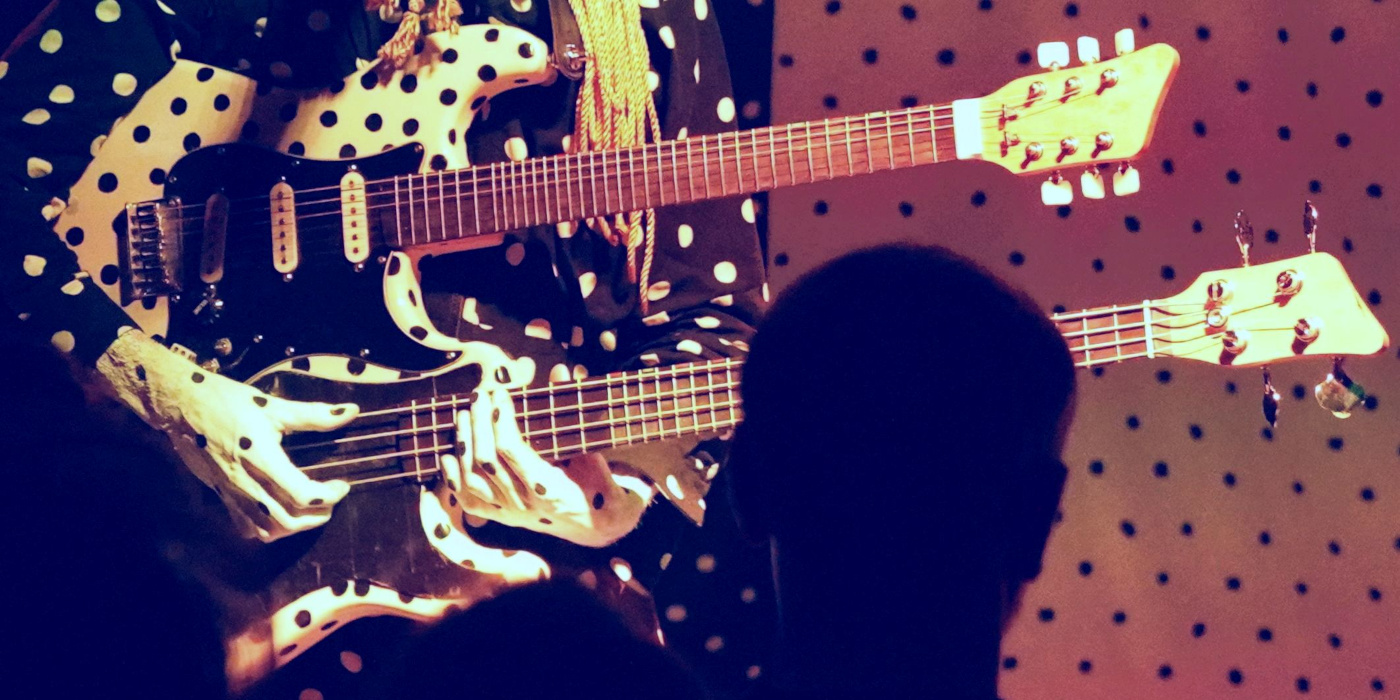
- Angine de Poitrine: This Canadian rock duo became viral sensations thanks to their papier‑mâché masks and black‑and‑white polka‑dot outfits. Underneath the striking visuals, their use of microtonal guitar adds an off‑kilter edge to their sound.
- Steve Vai: Never one to shy away from new sonic territory, Vai’s experimented with fractionally-spaced frets for years. He currently owns a unique JEM featuring 16 notes per octave (16‑TET), built as a replacement for a guitar he gifted to Jacob Collier. You can hear plenty of microtonal madness in Steve’s 1993 track “Down Deep Into The Pain”.

Why are guitarists turning to microtonal instruments?
There are a few good reasons why players are making the leap to guitars with microtonal frets:
- Creative saturation: The humble minor pentatonic scale has done a lot of heavy lifting over the years. And while it’ll never go out of style, many guitarists are craving something fresh. A microtonal instrument opens the door to brand‑new sounds that haven’t already been played to death.
- Influence of global music: Thanks to streaming, players are now exposed to musical systems far beyond Western harmony. When you’ve spent time with Middle Eastern, Indian or African music, the idea that a guitar should only have 12 notes per octave can start to feel a little limiting.
- Expression over speed: Microtonal playing rewards feel, phrasing and subtlety. It’s less about shredding and more about emotion, nuance and character. They’re great for players who want their guitar to say something and not just show off how fast they can play!
- Boundary‑pushing genres: Metal, prog, jazz and experimental scenes have always thrived on innovation. In genres where “normal” has never really been the goal, microtonality fits right in by offering new textures and unfamiliar tensions that keep things sounding exciting and unpredictable.
What’s the future of microtonal guitar?
We’re already seeing more production‑ready microtonal guitars hitting the market, along with better software and hardware support for alternative tuning systems. Add to that a new generation of players raised on global musical influences, and it’s clear that curiosity around microtonality won’t be slowing down anytime soon.
As music continues to drift away from rigid genre boundaries, microtonality feels less like something complicated or avant‑garde for the sake of it and more like a natural evolution. Will microtonal guitars replace standard six‑strings? No. But will they become an increasingly explored option for adventurous musicians? For sure.
Much like extended‑range 7-string guitars and baritone guitars did years ago, microtonality is slowly shaking off its “experimental only” label and settling in as another legitimate tool for pushing musical expression forward.
Microtonal guitars on Andertons TV!
Watch a blindfolded Rabea get to grips with a microtonal neck guitar for the very first time:
Shop microtonal guitar necks & instruments
Microtonal guitar FAQs
What is the difference between microtonal and normal guitars?
The main difference between a microtonal guitar and a normal guitar is the frets. Standard guitars divide an octave into 12 equal notes, while microtonal guitars add extra frets between those notes, allowing access to pitches “in between” the usual ones. This opens the door to new scales and unfamiliar chords that you simply can’t reach on a traditional instrument.
Which bands use microtonal guitars?
Microtonal guitars are most commonly used by experimental and progressive artists, but they’ve also found a home in modern metal, fusion and alternative music. Bands like King Gizzard & The Lizard Wizard and Angine de Poitrine have helped bring microtonal guitar into the mainstream, using it to create exotic-sounding riffs and hypnotic melodies that stand out from standard tuning systems.
What type of guitar does Angine de Poitrine use?
Angine de Poitrine uses a one‑of‑a‑kind, custom-built double‑neck microtonal guitar and bass hybrid, created in collaboration with Canadian luthier Raphaël Le Breton. This bonkers instrument marries a Stratocaster-shaped guitar with a Precision Bass and throws in extra frets to unlock weird and wonderful quarter‑tone intervals.
Is it hard to play a microtonal guitar?
A microtonal guitar isn’t necessarily harder to play, but it does require a different mindset. The extra frets can feel unfamiliar at first and your ears need time to adjust to the new intervals. That said, if you’re comfortable on a regular guitar and enjoy experimenting, a microtonal guitar can be incredibly inspiring once you get the hang of it!
Want to learn more?
For deeper dives, helpful how‑to guides and plenty of guitar‑friendly knowledge, head over to our learn section. And if you like to stay on top of the latest gear gossip, releases and industry news, our gear news page is well worth a bookmark.
Responses & Questions