Now, you might be wondering whether modular synths really have a place in the modern world. After all, with the ever-increasing abilities of digital synths and even plugins, why bother with the extra expense, not to mention all those cables! And if it all came solely down to sound, then that might be a smoking gun. But the simple truth is, modular isn’t just about sound – it’s about interaction. Turning knobs, patching cables, hearing immediate feedback. It’s all part of the wonderful tactile nature of modular synths, and it makes sound design feel more like sculpting than simply programming. You don’t just ‘click’ a setting, you physically shape it in real-time.
There’s no denying that modular software has come a long way in emulating the patching experience, with some incredible standout options like the u-he Bazille Virtual Modular Synth Plugin and Kilohearts Phase Plant SoftSynth. But analogue hardware does still hold several clear advantages:
- Latency-free performance: Instantaneous response with no buffering or processing delays.
- Hands-on control: Every knob, jack, and slider invites spontaneous creativity.
- Sonic depth and unpredictability: Analogue circuits can behave just a little bit differently each time, adding natural variation and richness.
- No screen fatigue: Modular hardware pulls you away from the mouse, letting you work with your ears and hands.
- Musical inspiration: Ask any analogue gearhead, and they’ll tell you that the mere presence of physical gear can often spark new ideas, simply by being there to interact with. What’s more, the limitations of a fixed interface can dispel that decision fatigue and push you to focus your thoughts in more creative ways.
Aside from these clear benefits, there’s something unquantifiable about getting your hands on analogue gear, the satisfaction of building your own signal path from the ground up. No menus, no presets, just pure sound shaping. If you enjoy a more visceral, exploratory approach to your music-making, modular hardware is seriously hard to beat. And with Behringer’s often unbeatable pricing, the entry barrier to modular has never been lower.
Is Behringer System 55 Worth It?
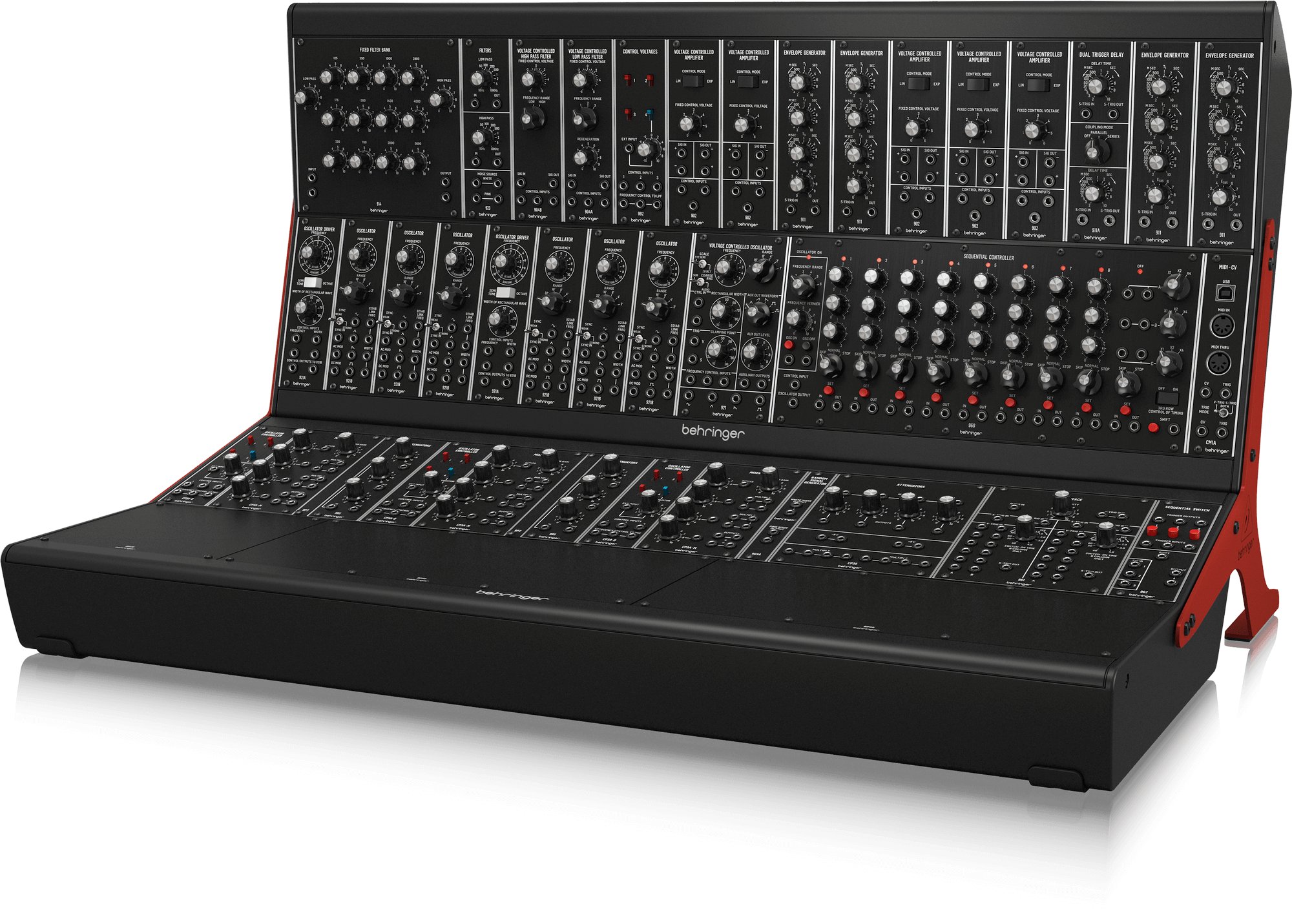
Short answer: yes – if you want real analogue modular sound without breaking the bank.
The Behringer 55 System offers undeniable value for money. A true modular system with 38 analogue modules, ready to patch out of the box, and all for a fraction of the price of a Moog or Buchla setup.
Compare it to virtual modular software, and you benefit from physical interaction, zero latency, and authentic analogue tone. Unlike software synths or desktop modules, there’s just something deeply satisfying about having that much analogue hardware at your fingertips. And unlike semi-modular synths, you’re not locked into a fixed signal path either. The Behringer System 55 is compact enough to fit into most home studios, but with enough real estate to really explore those complex patches and signal chains.
It’s ideal for:
- Newcomers wanting a taste of modular without DIY headaches
- Vintage synth fans craving Moog-style sounds
- Experimental musicians and sound designers
Behringer System 55 FAQs
What is the Behringer System 55 based on?
It’s based on the classic Moog System 55 from the 1970s, one of the most iconic modular synths ever produced.
Is the Behringer System 55 worth it?
We think so! It’s one of the most affordable ways to enter the world of modular synthesis, with over 35 analogue modules included at an unbeatable price.
How big is the Behringer System 55?
It’s housed in a 3-tier Eurorack cabinet, measuring approximately 664 x 420 x 165 mm and weighing in at around 12.3 kg.
What is the output of the Behringer System 55?
The System 55 operates with standard Eurorack-level audio and control voltage (CV) signals. Outputs are available from various modules:
- Audio outputs from the VCOs, VCF, and Mixers
- CV outputs from sequencers, envelopes, and LFOs
- Gate/trig signals from modules like the 960 Sequencer or 911 EG
While it doesn’t have a master output like a traditional synth, you can route final audio through the CP3A-M mixer into your audio interface or amp.
What’s included in the Behringer System 55 Complete?
38 classic-style analogue modules, a Eurorack case, and PSU. Just grab some patch cables and you’re ready to play.
What’s the difference between modular and semi-modular?
Modular synths have no fixed routing – you patch everything yourself. Semi-modular synths are typically self-contained and have a pre-set signal path, but you can override that with patching.
Can I expand the Behringer System 55?
Yes! It’s fully Eurorack compatible, so you can add more Behringer modules or other third-party Eurorack gear.
Is the Behringer System 55 good for beginners?
It certainly is. It’s designed to be a user-friendly entry into modular synthesis while still offering some serious sonic depth.
Behringer System 55: Final Thoughts
The Behringer System 55 punches well above its price. It’s a modular synth that gives musicians and producers access to that classic modular workflow with genuine analogue circuitry, all in a format that’s approachable, compact, and creatively inspiring.
Just as importantly, the System 55 is a system you can grow into. Its modular nature means that no matter whether you’re experimenting with your first patch or building intricate signal chains, it can develop with you. And with Behringer’s growing catalogue of Eurorack modules, there’s always something new to explore!
Further Reading
If you enjoyed this article and want to keep digging, check out the following Learn articles to take a deeper dive into the world of synthesizers:




Responses & Questions